
Hotspot Focus

Week 18 of “Mai Mai” Pathology Reading Notes | Immunohistochemical Markers for Diagnosis of Kidney and Urinary Tract Tumors (Part 2)


Preface:


In the previous issue, we mentioned the use of immunohistochemical methodsforkidney and urinary tracttumors is very necessary for diagnosis and differential diagnosis, and we provided a relatively detailed explanation ofcommonly used immunohistochemical markers for kidney tumors.This issue will further supplement and improve the immunohistochemical indicators for the diagnosis of kidney and urinary tract tumors.


图片

Table 1. Immunohistochemical characteristics of renal cell carcinoma of different histological types 

图片


Table 2. Key immunohistochemical points for renal clear cell carcinoma and other tumors with clear cell features

图片


Note:

  1. Positive in Xp11.1 translocation-associated renal cell carcinoma.


Table 3. Commonly used immunohistochemical markers for transitional cell carcinoma

图片


Note:

  1. Normal urothelium is CD44 positive;

  2. Normal urothelium is fascin negative;

  3. CK20 negative in high-grade carcinoma and inverted papilloma;

  4. Pax-8 can be positive in transitional cell carcinoma of the renal pelvis;

  5. β-catenin shows membranous staining in bladder adenocarcinoma and nuclear staining in colorectal adenocarcinoma.


Detailed explanation of some indicators


1


 Uroplakin

Positive expression pattern:Cell membrane/cytoplasm

Recommended positive control tissue: Bladder mucosa
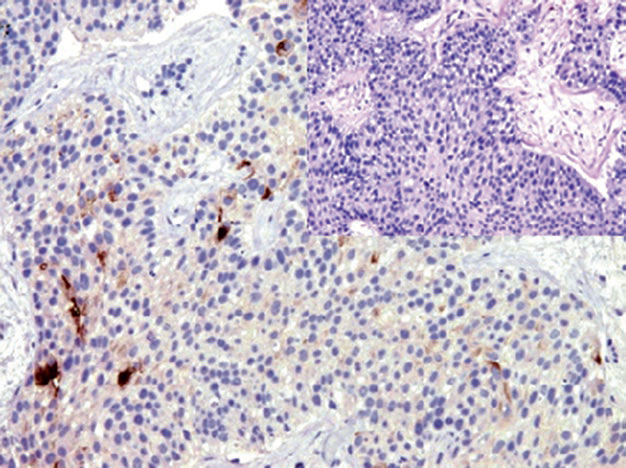

Uroplakin is a transmembrane protein expressed on the apical surface of mammalian urothelium, forming plaques approximately 0.2-0.5 micrometers in size, involved in strengthening the apical surface of the urothelium during bladder and urethral distension.Uroplakin can be divided into four subtypes, namely Ia, Ib, II, and III, all of which are expressed in the urothelium of the urinary tract and most tumors derived from this epithelium.Uroplakin Ia and Uroplakin II are specific to urothelium and are not expressed in other tissues or carcinomas except urothelial carcinoma;These two markers are also not expressed in primary squamous cell carcinoma or adenocarcinoma of the bladder.Uroplakin Ib can be found in several other epithelial cells, such as tracheal epithelium, bronchial epithelium, and mucosa with squamous metaplasia.Uroplakin III can also be found in the glandular epithelium of the prostate.Type II is the most commonly used antibody type in clinical work, while the expression of Uroplakin Ib and Uroplakin III should also consider the possibilities mentioned above. 

图片

Figure 1. Uroplakin shows positive expression in transitional cell carcinoma.


As mentioned earlier, antibodies against different Uroplakin subtypes can all be expressed in transitional cell carcinoma, but these markers are not expressed in 100% of transitional cell carcinomas, with a positive rate of only about 60%.Therefore, in clinical practice, it is also important to include a panel of other markers such as CK5/6, CK7, CK20, p63, GATA3, CD141, etc.In renal cell carcinoma, Uroplakin, GATA3, and CD141 are all negative, which can be used to differentiate it from transitional cell carcinoma.


2


  GATA3

General information about GATA3 has been introduced in the section on commonly used immunohistochemical markers for breast. Briefly, this marker can be expressed in breast luminal epithelium, urothelium, and some T lymphocytes. GATA3 is very helpful in the diagnosis of carcinoma of unknown primary metastasis, but when used for the diagnosis of transitional cell carcinoma, other markers must be added for auxiliary confirmation, such as CD141, Uroplakin, S100P. Positive expression of GATA3, CDX-2, and CK7, along with membranous positivity for β-catenin, is characteristic of primary adenocarcinoma of the bladder.

图片

 Figure 2. Transitional cell carcinoma, showing nuclear positive expression of GATA-3.


3


 S100P

General information about S100P has been introduced in this series of articles.Briefly, S100P can be expressed in normal urothelium and transitional cell carcinoma, but not in prostate cancer.However, S100P is not specific to transitional cell carcinoma, so its diagnosis and differential diagnosis must be considered in conjunction with a panel of other antibodies.


4


 Thrombomodulin

Thrombomodulin (CD141) is a transmembrane glycoprotein expressed on the surface of endothelial cells and various other cell types, such as mesothelial cells, stratified squamous epithelium, and urinary transitional epithelium. Therefore, this marker is helpful in the diagnosis of mesothelioma, transitional cell carcinoma, and vascular tumors. More details about this marker will be provided in the mesothelioma section of this series.

图片

Figure 3. High-grade transitional cell carcinoma of the bladder,showing CD141 positivity.

1


Mai Mai:”GATA3 is mainly expressed in breast cancer and urothelial carcinoma, and rarely expressed in other tumors. Its expression in breast cancer is positively correlated with ER and PR, and negatively correlated with HER-2. Besides being a specific marker for urothelial carcinoma, S100P can also be used in bile duct biopsy specimens to distinguish carcinoma from reactive epithelial changes. AndUroplakinII is expressed in urinary transitional epithelium and tumors derived from it, while it is almost not expressed in various tumors from other sites (such as respiratory tract, digestive tract, breast, etc.). Compared toUroplakin III,Uroplakin IIhas higher sensitivity, but data indicate thatUroplakin IIIcan be specifically expressed in p63-negative urethral epithelial tumors, including undifferentiated carcinoma.

Antibody Name

Clone Number

Positive Control

Cellular Localization

GATA3

L50-823

Urothelial carcinoma, Breast cancer

Nucleus

S100P

16/f5

Pancreatic cancer, Placenta

Nucleus/Cytoplasm

Uroplakin II*

MXR009

Urothelial carcinoma

Cytoplasm/Membrane

Uroplakin III

SP73

Urothelial carcinoma

Cytoplasm/Membrane

*Marked as Maxim clone products


For more information, please contact: 800-8581156 or 400-889-9853

发表回复

您的邮箱地址不会被公开。 必填项已用 * 标注