The SOX-10 gene is located on chromosome 22q13.1 and belongs to the SOX gene family. It is crucial for the survival and differentiation of neural crest-derived cells and can be expressed in almost all nevi and malignant melanomas, schwannomas, desmoplastic malignant melanomas, neurofibromas, granular cell tumors, and myoepithelial tumors, making it an effective marker for melanoma and neural crest-derived tumors. However, in recent years, more and more studies have shown that SOX-10 has a high positive expression rate in TNBC and is associated with the malignancy of this tumor. It can serve as an effective biomarker for the differential diagnosis and prognosis of TNBC and has the potential to become a therapeutic target for TNBC.
The Value of SOX-10 in Differential Diagnosis and Prognosis of TNBC
TNBC is a malignant tumor originating from breast myoepithelial cells, accounting for 15% to 20% of breast cancers. It is characterized by the absence of ER, PR, and HER-2 expression, early onset age, high heterogeneity, high metastatic potential, and high malignancy. There is currently no positive therapeutic ‘target,’ and the median overall survival time for patients is only 13 to 18 months. Therefore, it is necessary to find new diagnostic indicators.
Shi Ruifang et al. conducted an immunohistochemical study on 193 breast cancer tissues. The positive rate of SOX-10 in TNBC was 61.54%, while no expression was observed in HER-2 overexpressing, luminal A, and luminal B breast cancers (p < 0.05), suggestingthat SOX-10 has a good correlation with TNBC expression and can be used as a marker for TNBC diagnosis.
Liu Hui et al. conducted an immunohistochemical study on SOX-10 in 274 breast cancer specimens (including 48 TNBC cases and 226 non-TNBC cases) and 50 normal breast tissues. They found that the expression of SOX-10 in breast tissues is as shown in Figure 1: in normal breast tissue, it is only expressed in myoepithelial cells (Figure 1 ①); the expression rates in TNBC and non-TNBC were 60.4% (29/48) and 0 (0/226), respectively, with a significant difference (P < 0.001, Figure 1 ② ③),indicatingthat the expression of SOX-10 in breast tissue can be used for the differential diagnosis of TNBC and non-TNBC.

Figure 1 Expression of SOX-10 in Breast Tissue
(① SOX10 is expressed in normal breast duct myoepithelial cells; ②, ③ SOX10 shows diffuse strong positive expression in TNBC tumor tissue)
The study by Shirley K Jamidi et al. included 1766-1883 invasive breast cancer cases as test cases, with an additional 42 TNBC cases and 49 non-TNBC cases as validation cases. They found that SOX-10 was expressed only in a minority of invasive breast cancers, accounting for 6.9% (122/1777). Among these, the SOX-10 expression rate in TNBC was 31.3% (83/265), much higher than the 2.6% (39/1512) in non-TNBC. Among SOX-10 expressing TNBC cases, the basal-like phenotype accounted for 42.2% (49/116), significantly higher than the 22.8% (34/149) in the five-marker negative phenotype (5NP). In the validation cases, SOX-10 was expressed in 81.0% (34/42) of TNBC cases, with the basal-like phenotype accounting for 64.28% and the 5NP subtype accounting for 16.67%. The expression rate of SOX-10 in non-TNBC was only 2.0% (1/49), further confirming the high expression rate of SOX-10 in TNBC and the low expression rate in non-TNBC.
In this study, most SOX-10 positive cases (85.3%; 29/34) showed diffuse nuclear staining in >50% of tumor cells. All SOX-10 positive cases could exhibit heterogeneous expression, all with moderate to strong intensity (as shown in Figure 2), representing the characteristic staining of SOX-10 expression in whole sections.

Figure 2 Representative Staining of SOX-10 in Whole Sections
(A. Homogeneous expression of SOX-10 in TNBC; B. Heterogeneous expression; C. Adjacent normal lobules)
Consistent with the above study by Shirley K Jamidi et al., Katharina Kriegsmann et al. conducted an immunohistochemical study on 113 TNBC cases and found that SOX-10 expression was positively correlated with markers such as Ki-67 and vimentin, CD117, both of which are associated with poorer prognosis in TNBC. Additionally, this study found that SOX-10 expression in TNBC was significantly positively correlated with younger patient age (P = 0.001), higher histological grade (P = 0.003), and the presence of necrosis (P < 0.001),indicating that SOX-10 expression is associated with poorer prognosis.
Li Jie et al. collected clinicopathological data from 557 TNBC patients for immunohistochemical study and found that SOX-10 positivity reached 63.6% (354/557 cases). In this study, the survival rate and progression-free survival of SOX-10 positive TNBC patients were significantly lower than those of negative patients (as shown in Figure 3). Furthermore, the study also found that SOX-10 positivity was associated with malignant tumor characteristics, such as high histological grade (p < 0.001), more lymph node metastasis or vascular tumor thrombus (p = 0.001), high Ki-67 proliferation index (p < 0.001), etc., suggesting that SOX-10 can serve as a biological marker to assess patient prognosis and has the potential to become a therapeutic target for TNBC.
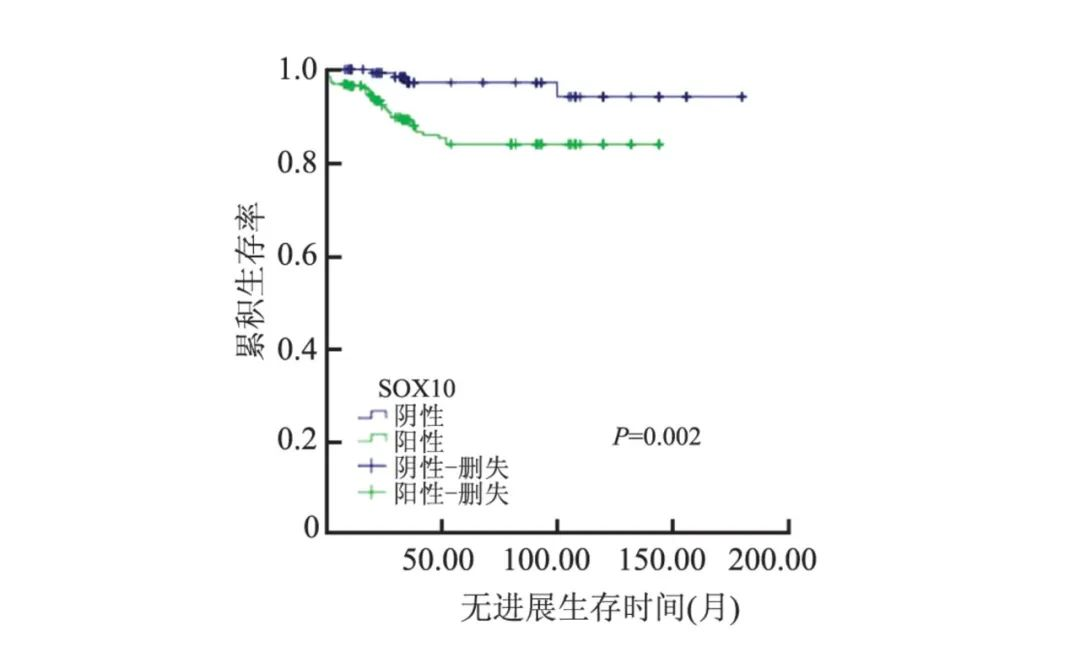
Figure 3 Relationship Between SOX-10 Expression and Progression-Free Survival in TNBC
In summary, SOX-10 has a high expression rate in TNBC, especially in the basal-like phenotype, but an extremely low expression rate in non-TNBC. In normal breast tissue, it is only expressed in myoepithelial cells. At the same time, SOX-10 expression is associated with poorer prognosis in TNBC. Therefore, SOX-10 can not only be used for the differential diagnosis of TNBC but also serve as a biomarker for patient prognosis assessment and has the potential to become a therapeutic target for TNBC.
Related Antibodies from Maxim
|
Antibody Name
|
Product Number
|
Clone Number
|
Cellular Localization
|
|
SOX-10
|
RMA-0726
|
EP268
|
Nuclear
|
References:
[1]Jamidi S K , Hu J , Aphivatanasiri C , et al. Sry‐related high‐mobility‐group/HMG box 10 (SOX10) as a sensitive marker for triple‐negative breast cancer[J]. Histopathology, 2020.DOI: 10.1111/his.14118
[2]Kriegsmann K , Flechtenmacher C , Heil J , et al. Immunohistological Expression of SOX-10 in Triple-Negative Breast Cancer: A Descriptive Analysis of 113 Samples[J]. International Journal of Molecular Sciences, 2020. DOI: 10.3390/ijms21176407
[3] Li Jie, Li Shi, Li Fang, et al. Expression and clinical significance of AR, SOX10, EGFR and PD-L1 in triple-negative breast cancer[J]. Journal of Clinical and Experimental Pathology, 2021, 37(3): 344-347
[4] Shi Ruifang. Expression of SOX10 in breast cancer tissues and its correlation with clinicopathological features[J]. China Health Standard Management, 2017, 8(4): 125-126
[5] Liu Hui, Ren Yujie, Yang Jingru, et al. Expression and significance of SOX10, GATA3 and GCDFP-15 in triple-negative breast cancer[J]. Journal of Diagnostic Pathology, 2021, 28(11): 950-953, 968.
For more information, please contact: 800-8581156 or 400-889-9853