Geórgios Nikoláou Papanikoláou was a Greek pathologist, now known by the name Georges Nicholas Papanicolaou. He was a pioneer in cytopathology and early cancer detection, and also the inventor of the ‘Pap smear’.

From 1995 to 2001, his portrait appeared on the front of the Greek 10,000-drachma banknote until it was replaced by the euro.

Denomination 10,000 Drachmas (Portrait of Geórgios Papanikoláou)
Next, let’s learn about the story of Geórgios Papanikoláou. It was the great achievements of this pathologist that helped save the lives of tens of millions of women.
Studying Medicine in Youth, Lofty Aspirations
In 1898, at the age of only 15, Papanikoláou successfully entered the Medical School of the National University of Athens. After graduation, he served as a surgeon in the army for a period of time.Assistantdoctor. In 1904, he returned to his hometown in Greece, and for the next two years, he cared for leprosy patients in the countryside of his hometown.
Papanikoláou also used this time in his life to study philosophy and biology. However, he found scientific research more fascinating. Realizing this, his father decided to send him to Germany for further studies. It was during this time that Papanikoláou decided to make research and biology his life’s goal, and he earned a Ph.D. in zoology in 1910.
Keen on Discovery,Versatile
In 1843, Professor and physician Walter Hayle Walshe (1812-1892) of University College Hospital in London first pointed out in a book on lung diseases the fact that malignant cells could be seen under a microscope, which greatly influenced and inspired Papanikoláou.
Encountering Love, Sharing Weal and Woe
In 1910, after returning to Greece, Papanikoláou married the well-educated and open-minded Andromache Mavroyeni (Mary). In 1913, he and his wife came to New York, USA. The couple’s initial days were quite difficult—Papanikoláou made a living by selling carpets and playing the violin in restaurants, while Mary earned $5 a week sewing buttons, but he soon overcame the hardships.
In October 1914, he finally obtained a position in the Department of Pathology at New York University and the Department of Anatomy at Cornell University Medical College, where he worked for 47 years. His wife later worked as a technician at Cornell University, sometimes also serving as a research subject.
Finally Achieving Results, Yet Facing Doubt
Although Papanikoláou’s research was ultimately applied to humans, his initial research began with guinea pigs. In 1920, at the age of 37, Papanikoláou began focusing on the cytopathology of the human reproductive system. He was very excited when he could distinguish between normal and malignant cervical cells simply by observing swabs smeared on microscope slides.
In 1923, Papanikoláou told an incredulous audience of physicians about a non-invasive technique where cellular debris could be collected from the vaginal lining and smeared on a slide for microscopic examination as a method to identify cervical cancer. Five years later, at a medical conference in Battle Creek, Michigan in 1928, Papanikoláou introduced his low-cost, easy-to-perform screening test for early precancerous and cancerous cells, but again faced skepticism and resistance from the scientific community.
Unwavering Devotion, Finally Gaining Recognition
Due to his previous research on female guinea pigs, Papanikoláou had already noticed cellular changes and wanted to confirm this phenomenon in human females. Coincidentally, one of Papanikoláou’s human subjects had cervical cancer. His first clinical trial demonstrated the diagnostic value of smear cytology. This work laid the foundation for his method of early diagnosis of cervical cancer, but his achievements were heavily questioned by the American medical community.
Papanikoláou firmly believed in his research results and continued his studies. He eventually proved that lesions could be observed and correctly classified in smears of normal and abnormal cells taken from the cervix. Subsequently, he collaborated with gynecological pathologist Dr. Herbert Traut, and finally in 1943, they published their landmark work ‘Diagnosis of Uterine Cancer by the Vaginal Smear’.
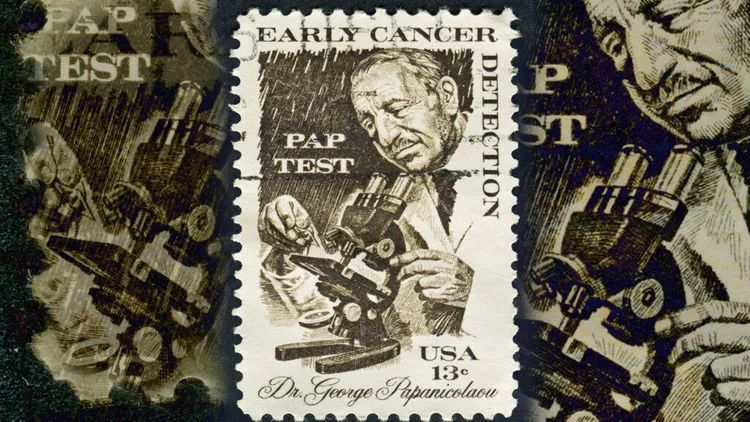
In 1978, the United States Postal Service issued a 13-cent commemorative stamp honoring Papanikoláou.
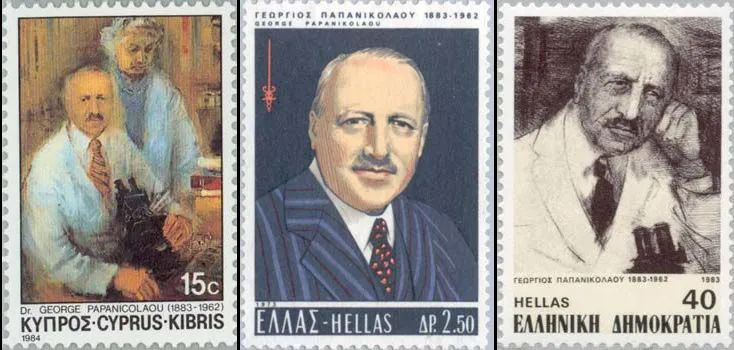
Other various commemorative stamps issued with Papanikoláou as the theme
“The first observation of cancer cells in a cervical smear was the greatest thrill I experienced in my entire scientific career.” — Geórgios Papanikoláou
After Papanikoláou became famous, doctors and other scientists from around the world flocked to the Cornell University laboratory to learn from him and study his examination technique. He never took vacations, worked 7 days a week, and happily immersed himself in the wonders of his research. His method, now known as the Pap smear test, became the standard for screening cervical cancer. Papanikoláou never won a Nobel Prize but was nominated twice.
In 1951, Papanikoláou became an emeritus professor at what was then Cornell University Medical College, and today two laboratories are named after him. In 1954, he published ‘Atlas of Exfoliative Cytology,’ a comprehensive paper containing information on normal and abnormal cytology, not only of the female reproductive system but also of other organ systems. Papanikoláou authored a total of four books and over one hundred articles. He received numerous awards, including honorary degrees from universities in the United States, Italy, and Greece. The scientific community honored him with the Borden Award from the Association of American Medical Colleges (1940), the Amory Prize from the American Academy of Arts and Sciences (1947), the prestigious Albert Lasker Award for Clinical Medical Research from the American Public Health Association (1950), and the Medal of Honor from the American Cancer Society (1952). Additionally, he was awarded honorary memberships in the Athens Society of Obstetrics and Gynecology and the New York Academy of Sciences.
Vilos made a fair assessment of Papanikoláou’s life: “His immense contribution proves that cancer can be defeated… The Pap screening test will remain one of the most powerful weapons against this disease. Those of us who see him as a guiding light will always owe him a debt of gratitude, and those women who have been helped by the Pap smear owe him their lives.”
References:
Vilos GA. The history of the Papanicolaou smear and the odyssey of George and Andromache Papanicolaou. Obstet Gynecol. 1998;91:479–83.