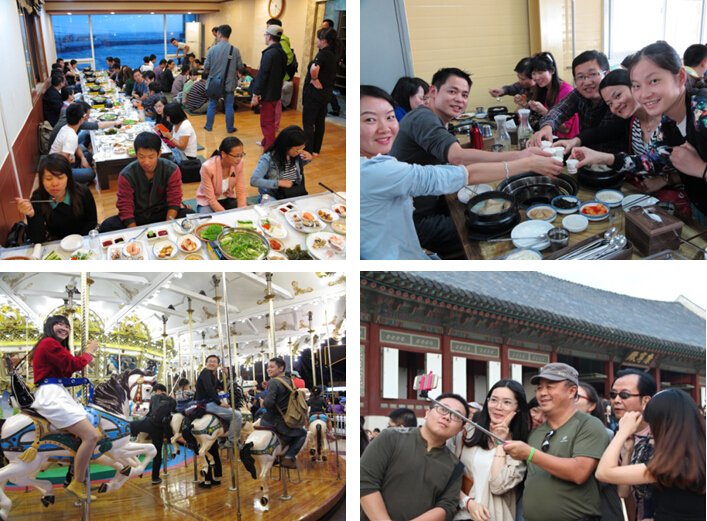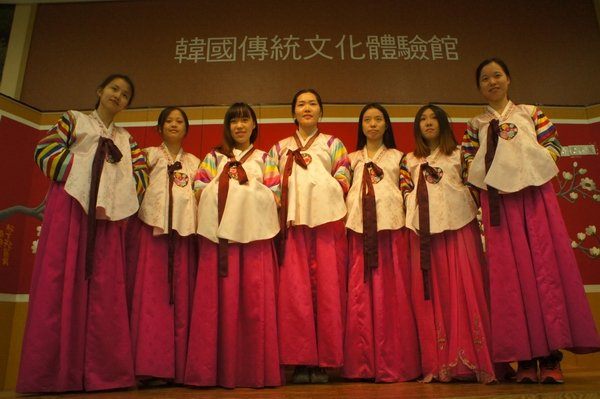
On the Road – Romantic Korea

The azure sky, deep and distant!
The fiery red maple leaves, light and romantic!
Carrying countless hopes and following the fragrant ginkgo, the new companions of this autumn set foot on the land of South Korea, beginning a wonderful and romantic journey!
The Taegukgi, Korean dramas, plastic surgery, kimchi, tteokbokki… This is probably the impression many Chinese have of South Korea. However, few people trace the origins of why so many in China have become fans of Korean culture.
The moment we set foot on the Korean Peninsula, many of these questions seemed to slowly find answers.
“Annyeonghaseyo”… A thoughtful greeting from our local tour guide marked the beginning of our journey. The Korean guides were two typical Koreans, and their fluent Chinese was truly astonishing. Following the guide’s directions, we passed through the airport hall and arrived at the spacious parking lot. Among the orderly cars, it was easy to find the bus waiting for us. Unlike tour buses in mainland China, besides the neat welcome sign from the tour leader, the bus was adorned with a “Korean pastoral style…” Pastoral-style fabrics were neatly arranged in every corner of the bus. The spotless seat cushions, cozy stickers, and colorful teddy bears made it hard to believe this was the bus responsible for our entire trip. We had already heard about the excellent service attitude in the Japanese and Korean tourism industries and had some small expectations, but this scene far exceeded everyone’s expectations.
The guide accompanying us was a thin, petite woman with a pure smile reminiscent of “Dae Jang Geum.” After enjoying a very local “Hanjeongsik” meal, she began to introduce us to Jeju Island.
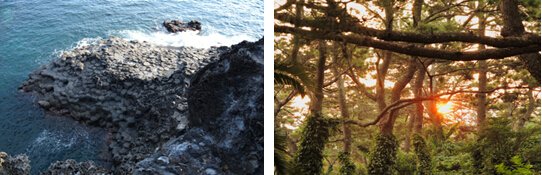
Scattered around the Korean Peninsula are many islands of various sizes, with Jeju Island being the largest. Centered around Hallasan Mountain, surrounded by strange rocks and cliffs, and encircled by the sea, it is a typical volcanic island, often called “the Hawaii of Korea.”
Long ago, in Korean dramas, Koreans often spoke of Jeju with a look of longing, as it was their dream romantic honeymoon destination at the time. Today, due to convenient transportation and other reasons, Koreans visiting Jeju has become commonplace. However, those traditional beautiful memories, along with the stunning scenes from dramas like “Dae Jang Geum,” still give Jeju Island an unparalleled lofty status in the hearts of Koreans. To them, it is a—dream paradise.
Upon first arriving at the “dream paradise,” one could only feel the air filled with simplicity and clarity. The magnificent natural scenery, the azure sea, and the white sandy beaches complemented each other. The brilliant sunlight descended through the blue sky and white clouds, bringing a warmth that evoked gratitude.
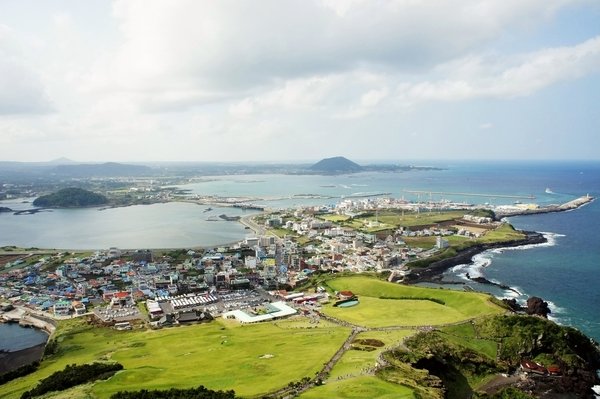
The unique formation of Jeju Island makes it vastly different from other islands. Whether standing by the roaring sea admiring Yongduam Rock or the independent rock formed by solidified lava from a volcanic eruption, when the sea breeze blows, there is no feeling of dust flying. These wonders created by great natural forces are all awe-inspiring! As foreign guests gradually immersed in this “dream paradise,” we felt deeply moved. Beyond the mild and humid climate and the unique volcanic rock scenery, we were more impressed by the island’s simple folk customs and unique cultural heritage.
According to the guide, Jeju Island is famous for its “three abundances and three absences”: many rocks, much wind, and many women. Located in a typhoon belt and formed by volcanic eruptions, Jeju has the peculiar phenomena of many rocks and much wind. The ancient Jeju people started from scratch on this rocky land. The stone houses and thatched cottages scattered in the folk villages on the island seem to tell travelers about the hardships of Jeju’s ancestors.
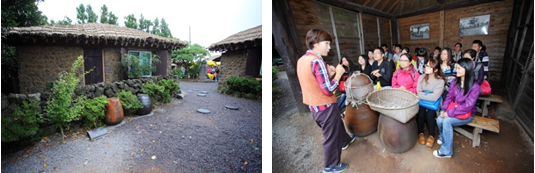
“Many women” is due to the high mortality rate of Jeju men who went out to sea to fish in ancient times, resulting in more women than men. This is somewhat similar to the Hui’an women in Fujian, China. The haenyeo (female divers) who risk diving into the turbulent sea to catch abalone, shellfish, seaweed, and other seafood along the shores of Jeju can be said to represent the “island of many women.”
The Jeju people have lived on this barren land since ancient times. The harsh living conditions fostered a virtue of mutual assistance among neighbors, so no one needed to rely on theft or begging for survival. Naturally, there was no need to set up gates to guard against neighbors, which explains the “three absences.”
As foreign tourists, besides experiencing the island’s beautiful scenery and unique folk customs, we were deeply impressed by the national quality and systems here. Seventy percent of Jeju Island is hilly, which means trees, roads, houses, and even parking spaces can only exist in a slanted manner. There is not a single traffic police officer on the entire island; all vehicles are monitored by electronic police. However, no one takes chances; everyone drives in an orderly manner. At traffic light intersections, all vehicles automatically yield the zebra crossing to pedestrians. Despite many vehicles, there is rarely any honking… (Part 1)
On the road from Jeju to Seoul, our accompanying guide kept making phone calls, explaining, and answering various questions. You never saw her tired, annoyed, or indifferent.
From her, one could see the rigorous work attitude of Koreans. At every scenic spot, she would explain meticulously without omitting anything… With all kinds of curiosity, we soon arrived in Seoul—a city that blends modernity and classicality, ancient and magnificent!
The slowly flowing Han River passes through the city like a jade belt, flowing freely.
The solemn and dignified Blue House, the magnificent Gyeongbokgung Palace, and the fiery red maple leaves of Nami Island—various typical Korean-style buildings mixed with falling leaves from various trees create an ultimate romantic atmosphere!
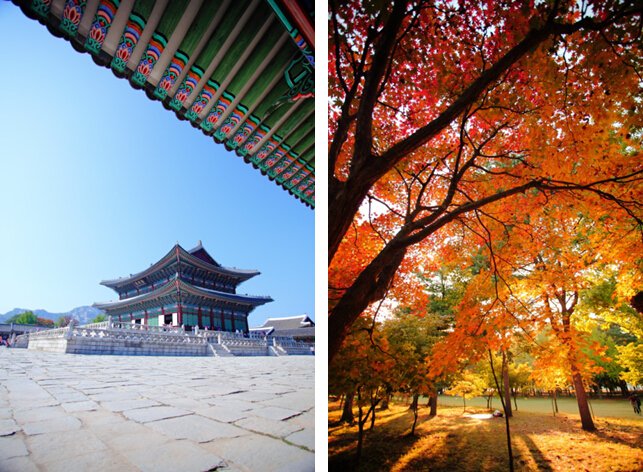
Of course, besides the beautiful scenery, Seoul also attracts tourists with its rapidly developing economic system. During conversations, the guide introduced us to the “Miracle on the Han River.” Before the 1960s, South Korea was one of the poorest countries in the world, and Koreans were among the most looked-down-upon people. When Park Chung-hee came to power, he bluntly pointed out that Koreans lacked independence, were lazy, selfish, full of mutual hatred and factionalism, and called for the transformation of the national character.
Over a few decades, Seoul’s economy developed rapidly, transforming from one of the world’s poorest and most backward countries into a developed nation. In the 1980s and 1990s, South Korea relied on technological innovation and the development of the IT industry to become a technological powerhouse. This is inseparable from the unity, diligence, competitiveness, cleanliness, and seriousness of Koreans.
These national qualities can also be seen in the surrounding environment. The vehicles on the streets of Jeju or Seoul are almost exclusively from a few brands like Hyundai, Kia, and Samsung, with few imported cars. This is a prominent manifestation of their strong support for domestic products.
Strict hygiene management systems: the government implements rigorous measures for environmental sanitation. Every restaurant we saw during the trip strictly followed waste classification standards. It is said that South Korea has the strictest waste classification in the world, divided into food waste, recyclable waste, large waste items, and general household waste, with different bins for different types of trash.
Strong environmental awareness: In Korean restaurants, disposable tableware is not seen. The chopsticks on the table are flat stainless steel ones, which save a lot of steel, have a long lifespan, and are easy to sterilize. The essential toothpicks on the table are simplified into starch toothpicks in Korea, which decompose easily and are both beautiful and environmentally friendly.
Many small aspects of daily life reflect various facets of Korean national quality, showing the high level of support from the Korean government for public services and system construction. At the same time, it reminds us of the Korean government’s emphasis on exporting its national culture. Many prestigious universities in South Korea offer graduate programs in Korean Wave culture studies to develop and export Korean culture, with Korean dramas being a successful cultural export.
An entertainment channel of a certain website once conducted a large survey titled “How do you view the Korean drama craze?” Among 56,006 participants, 81% admitted to enjoying Korean dramas. From female students, office workers, middle-aged mothers, to 60-year-old seniors, Korean dramas are like a mixed pot, carrying emotional elements such as youth, fashion, and warmth, satisfying the psychological needs of women of different age groups.
The beauty of humanity promoted in Korean dramas meets the needs of social reality. The hardworking, resilient, optimistic, pure, and kind-hearted female protagonists provide female viewers with a space to relieve psychological anxiety and even have the effect of uplifting spirits and purifying hearts.
Most Chinese people like Korean dramas. Rather than saying they are fans of Korean culture, it is more that they place their hopes for a better life in them, seeking the warmth and emotions increasingly missing in this transitional society. It seems that Koreans have found a path suitable for their cultural development: using a gentle and persistent approach to narrate Eastern ethical virtues, expressing the eternal themes of people’s desire for communication, understanding, and mutual affection…
As the journey nears its end, looking back, our trip also conveyed the power of unity and mutual affection. Acts of kindness like returning lost property, carrying luggage, helping with shopping, giving directions, gathering people… all these small helpful deeds intertwined and gathered, weaving beautiful memories, like a cup of strong coffee or a cup of light tea…
Unforgettable South Korea is not only because of its authentic Korean kimchi, Hanjeongsik, seafood sashimi… and various delicacies, but more because of the tranquility and peace here. It is like a beautiful Korean drama, flowing slowly past. Even when the ending credits appear, one is still reluctant to leave.