Hotspot Focus

Lynch Syndrome | The Predestined Inheritor


Introduction:


Before getting to the serious matter, the editor will first tell a little story.There is a young man in the Netherlands who lived a turbulent life, wandering from place to place, but fortunately, after many twists and turns, he finally found his biological father.At this time, his father had just passed away, leaving an inheritance of 100 million euros for him to inherit.

After becoming rich overnight, he indulged in a life of extravagance and debauchery all day long. Not long after, the young man fell ill. After a series of examinations, he was diagnosed with Lynch syndrome. Coincidentally, his father also passed away due to Lynch syndrome. While he was fortunate to inherit his father’s fortune, he also regrettably inherited the family genetic condition.


Ahem, back to the main topic. It’s important to know that what the chosen one might inherit besides property could also be certain hereditary diseases!

● Lynch Syndrome


Lynch syndrome, also known as hereditary nonpolyposis colorectal cancer, is a specific type of colorectal cancer that tends to occur between parents and children. Its cancer risk is several times higher than that of the average person, meaningIt’s hereditary! It’s hereditary! It’s hereditary!Important things need to be said three times.
Therefore, family members of patients with MMR pathogenic mutations also need to undergo genetic screening, testing, and follow-up to rule out Lynch syndrome. Meanwhile, MMR testing not only plays a significant role in preventing familial colorectal cancer but also has important implications for patient prognosis and medication selection.

● Causes of Cancer in Lynch Syndrome


Lynch syndrome is mainly caused by mutations in genes related to the DNA mismatch repair (MMR) system. What is MMR? First, we need to talk about what MSI is.
The principle of MSI occurrence is like a primary school student copying from a textbook. The student copies while looking at the textbook (DNA replication), but during the copying process, mistakes can be made (MSI occurs). It could be that a single character (single base) is copied many times, or several characters (multiple bases) are copied repeatedly. As these errors accumulate, they form varying degrees of mistakes (MSI-L, MSI-H).
What does this have to do with MMR?MMR is similar to the child’s parents. When the child makes mistakes while copying the textbook, the parents can check and correct the errors (MMR).If the child’s parents themselves make mistakes due to illness or other reasons (dMMR), causing them to have no time to manage and educate the child, then in such an environment, the child is likely to be careless with homework and make various errors (MSI). At this point, the parents are also unable to check and correct them. Therefore, it can be simply considered that the parents’ issues (dMMR) lead to varying degrees of errors in the child’s homework (MSI). The ultimate impact is a decline in grades (tumor occurrence). So, it can be said that the parents’ problems (dMMR) are closely related to the child’s declining grades (tumor occurrence).

● Detection Methods


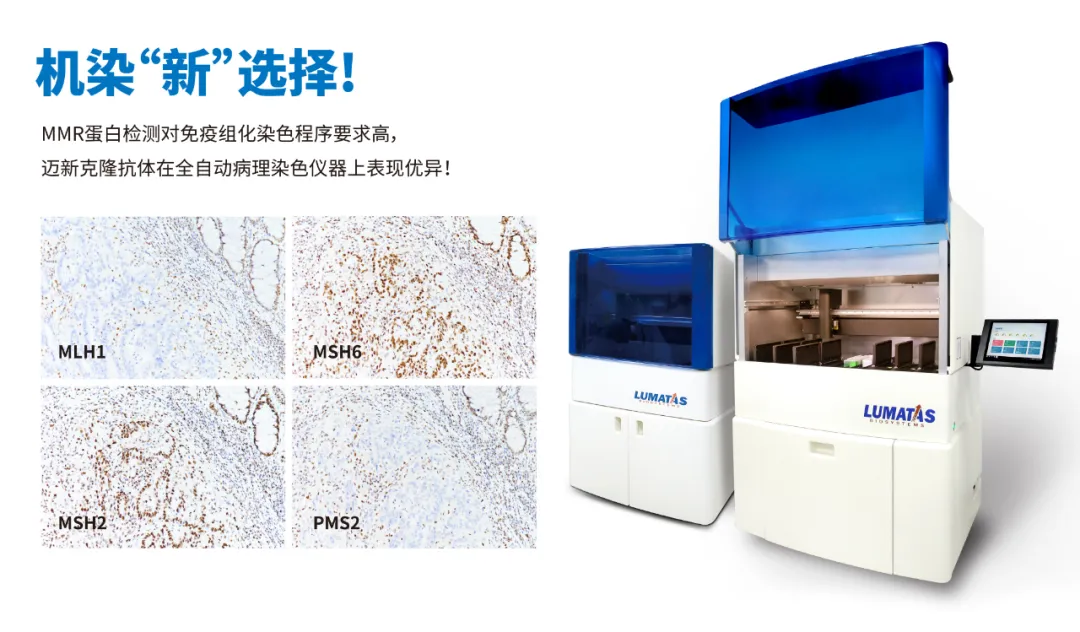
Immunohistochemistry for detecting MMR proteins (MLH1, MSH2, MSH6, PMS2) has advantages such as strong accessibility, simplicity, and the ability to indicate mutated genes, making it an irreplaceable method for Lynch syndrome screening.

● Result Interpretation


How to interpret the staining results of the four antibodies? Professional pathologists are here to help!
If you want to learn more? You canclick below “IHC Detection of MMR Proteins Series of Articles” toDetailedexplain the detection and interpretation of mismatch repair proteins.

Easter Egg at the End            


For those who have read this far, to thank you for your patience, the editor wants to tell you a shocking secret! That is, our special lecture is coming soon, so stay tuned!

发表回复

您的邮箱地址不会被公开。 必填项已用 * 标注