
Comparison of Current Status of Clinical Pathology Laboratories in China and the United States

Comparison of the Current Status of Clinical Pathotechnology Laboratories between China and the United States. The clinical pathotechnology laboratory is an important component of clinical pathological diagnosis work in teaching hospitals of medical colleges, various clinical hospitals, and independent diagnostic laboratories. Its task is to apply conventional histology, immunohistochemistry, molecular pathology, and other technologies to meticulously process human tissue, cell, blood, and other body fluid specimens, providing technical support for accurate diagnosis by professional pathologists.
However, the continuous development of modern science and technology and clinical medicine has placed higher demands on the standardized management, quality control, and technical personnel qualifications of clinical pathotechnology laboratories in both China and the United States. Contradictions such as the constant updating of new knowledge and technologies and the shortage of pathological technical talents have become prominent.
Clinical pathotechnology laboratories in China and the United States each have their own advantages in many aspects, such as standardized construction, institutional management, hardware configuration, and talent cultivation. The advantages of clinical pathotechnology laboratories in the United States are mainly reflected in the standardized construction and management of laboratories, subspecialty characteristics, qualification certification and recognition, and international exchanges. The advantages of clinical pathotechnology laboratories in China are mainly reflected in the increase in hardware investment, improvement of working environments, growth in the number of technical reserve talents, and enhancement of educational backgrounds. Based on the professional experience of one of the authors in clinical pathotechnology laboratories in both China and the United States [Chinese professional qualification: Senior Laboratory Technician; American professional qualifications: Histotechnologist (HTL) certification from the American Society for Clinical Pathology (ASCP) and Clinical Laboratory Technician (CLT) license issued by the New York State Education Department (NYSED)] and personal observations, we compare the current status of clinical pathotechnology laboratories in China and the United States in terms of laboratory construction and positioning, standardized management, qualification certification and recognition, and talent education and training. We focus on analyzing the strengths and weaknesses of both sides to provide useful experience for standardizing the management of clinical pathotechnology laboratories, selecting and training technical talents, and improving professional technical levels.
In comprehensive medical schools in the United States, the pathology department mainly includes three major sections: teaching, research, and clinical diagnosis. The function of clinical diagnostic services is undertaken by independent clinical departments, including laboratories such as clinical pathology (surgical pathology), clinical chemistry (medical laboratory science), blood bank, and biobank. Clinical pathotechnology laboratories are divided according to functional characteristics into histology laboratories, special stain laboratories, intraoperative frozen section rooms, electron microscopy laboratories, immunohistochemistry laboratories, molecular pathology laboratories (including hybridization group, PCR group, sequencing group, etc.); and according to subspecialty characteristics into grossing rooms, cytopathology laboratories, renal pathology laboratories, neuropathology laboratories, hematopathology laboratories, etc. Each laboratory operates relatively independently but can share some common functional laboratories, such as the main histology laboratory. Some laboratories have independent personnel authority, with independent accounting for instruments, equipment, and operational income, and part of the income is submitted to the department annually on a proportional basis.
In comprehensive medical institutions in China, the pathology department is a single medical-technical auxiliary department solely responsible for clinical pathological (surgical pathological) diagnostic services. In recent years, some large hospital pathology departments have established clinical pathological diagnosis centers, also expanding functional laboratories such as molecular pathological diagnosis and biobanks. Clinical pathotechnology laboratories are mainly divided into histology laboratories, special stain laboratories, intraoperative frozen section rooms, immunohistochemistry laboratories, and molecular pathology laboratories (hybridization group, PCR group, sequencing group, etc.). However, in terms of subspecialty construction, most pathology departments have not established well-developed subspecialty-specific laboratories. Therefore, there is no significant difference in the functional characteristics of clinical pathotechnology laboratories between China and the United States, but China has made slower progress in subspecialty construction.
We particularly observed that in terms of hardware investment such as laboratory working environments and instrument equipment, the construction of clinical pathotechnology laboratories in China has fully caught up, and even the environments and large-scale new instrument equipment in some laboratories have surpassed the average level in the United States. Regarding the recognition and certification of clinical laboratory qualifications, clinical pathotechnology laboratories and technical personnel in the United States must obtain qualification certification and pass annual evaluation inspections. China started late in this aspect, and only a few departments have been awarded qualification recognition and certification in recent years.
In the United States, the management personnel of clinical pathology laboratories generally consist of the deputy department head in charge of clinical pathology, the director of the clinical pathology laboratory, the heads of various specialty laboratories, and group leaders. The heads of various specialty laboratories have independent personnel authority, responsible for recruiting, training, and dismissing employees. In China, the management personnel of clinical pathology laboratories generally consist of the deputy department head in charge of the laboratory, the laboratory head, and group leaders. Personnel authority belongs to the department head and the hospital’s personnel department.
In clinical pathotechnology laboratories in the United States, various specialty laboratories work independently, each undertaking clinical pathological technical services, and technicians have fixed job positions. For specialty laboratories requiring special skills, such as cytopathology laboratories and grossing rooms, the work is undertaken by qualified cytotechnologists and pathologists’ assistants. The technician position settings in various functional laboratories vary by specialty. For example, in main histology laboratories, special stain laboratories, and intraoperative frozen section laboratories, technician positions are rotated periodically, but positions for automated staining are relatively fixed, such as in immunohistochemistry laboratories and molecular pathology laboratories, where technician positions are fixed. Additionally, clinical pathotechnology laboratories do not provide technical services for scientific research; each technician is only responsible for duties within their own position scope, and technicians are also allowed to work part-time in pathology laboratories of different institutions. In hospitals or diagnostic companies handling large specimen volumes, technician shift schedules are usually set from Monday to Friday, divided into day shift (8:00 to 16:00), evening shift (16:00 to 24:00), and night shift (24:00 to 8:00 the next day).
In clinical pathotechnology laboratories in China, except for fixed technician positions in immunohistochemistry laboratories and molecular pathology laboratories, technician positions in other laboratories are rotated, including assisting in grossing, cytology slide preparation, intraoperative frozen sections, and other routine pathological technical positions. Therefore, technicians on rotation undertake a large amount of technical services and auxiliary work. Some technician positions also involve part-time responsibilities for scientific research services. In hospitals handling large specimen volumes, technician shift schedules are usually set from Monday to Friday, divided into early day shift (6:00 to 14:00) and day shift (8:00 to 16:00), with weekend duty on rotation.
Both Chinese and American clinical pathotechnology laboratories have established strict quality management systems and established quality control centers at various levels. However, there are still significant differences in specific quality management and operational work.
In the United States, clinical pathotechnology laboratories generally have national, state, and municipal quality management supervision committees. These institutions are often independent evaluation and inspection agencies. Inspection contents include personnel qualifications (technician certification or license), laboratory qualifications (authorization for clinical sample processing), quality standard systems, etc. During annual inspections, if quality standards are not met or quality supervision issues arise, minor cases require rectification within a time limit, while severe cases may lead to laboratory closure. There are also internal quality control institutions within the industry. Annual inspections generally target specific specimen standardization processing procedures and quality supervision systems, such as specimen error rates, diagnostic misdiagnosis rates, positive/negative control sample setup rates, etc. Internal laboratory audits generally include document system management, pathological data management, reagent usage management, equipment temperature control management, etc.
In China, national or regional clinical pathology quality control centers have been established, conducting inter-laboratory quality control assessments irregularly. Internal quality control groups within laboratories also conduct irregular quality checks and case reviews. However, only a few pathology departments and independent laboratories have passed standardized certification, and a small number of practitioners have passed regional qualification certification and internal auditor or assessor recognition from laboratory accreditation bodies. Overall, the quality control system for clinical pathology in China is still being continuously established and improved.
Includes fire and theft prevention, chemical protection, biosafety, occupational health, etc. Clinical pathotechnology laboratories in the United States conduct 3 to 4 sessions of safety training and education for all personnel annually, covering fire escape knowledge, xylene and formaldehyde protection training, chemical reagent management regulations, occupational health check-ups, etc. Irregular monitoring of formaldehyde and xylene levels at workstations is conducted, and laboratory waste liquids are regularly collected weekly. In case of spills of acid-base reagents, highly toxic reagents, or carcinogenic reagents, the chemical management department should be reported, and professionals will handle the cleanup. Regular inspections and registration of chemical reagent usage and storage conditions are conducted. Strict regulations exist for the storage quantity and unit storage area of flammable and explosive reagents such as ethanol and acetone. Laboratory waste is sorted and collected for centralized disposal.
Clinical pathotechnology laboratories in China also conduct irregular safety training and education for all personnel, such as fire escape knowledge, chemical reagent management regulations, occupational health check-ups, etc. However, monitoring of chemical reagents, especially formaldehyde and xylene, is still very inadequate. Hospitals lack specialized chemical management supervision departments, and there is a lack of effective supervision and management for chemical reagents, especially acid-base reagents, highly toxic reagents, carcinogenic reagents, and flammable and explosive reagents. Internal laboratory management regarding the use, storage, waste liquid recovery, and emergency accident handling of chemical reagents is also unclear in tasks and responsibilities, and insufficient attention is paid to the chemical and biological safety protection of laboratory staff.
The educational backgrounds of technicians in clinical pathotechnology laboratories in the United States vary. Most complete their studies in biomedical sciences, medical laboratory science, or related fields at accredited or approved two-year community colleges or four-year universities. However, some entry-level technicians may only have a high school diploma. With the significant increase in immigration, the number of pathology technicians with bachelor’s and graduate degrees and richer professional experience has been increasing year by year.Basic courses required for pathology technicians include biology, chemistry, physiology, biochemistry, human anatomy, histology, pathology, pathophysiology, parasitology, microbiology, etc.
In clinical pathotechnology laboratories in China, early technicians mostly had secondary specialized education, with some upgrading to bachelor’s degrees while working, and their majors were often inconsistent. Over the past 20 years, a large number of graduates with associate and bachelor’s degrees in medical laboratory science and biotechnology have joined the pathology technician workforce. Especially in recent years, many master’s and even doctoral degree holders have become pathology technicians. With the emergence of highly educated talents, the new generation of pathology technicians not only masters basic medical knowledge but is also familiar with and proficient in modern pathological techniques such as immunopathology, molecular biology, and chip technology.
In the United States, clinical pathology laboratories in some states like New York and California require clinical technicians to have licenses, such as a Clinical Laboratory Technician license. Technicians can apply for clinical laboratory technician licenses in various states based on their education, degrees, professional certification, and work experience. Currently, most clinical pathology laboratories require applicants to have technician certification issued by the ASCP Board of Certification and relevant work experience. Technician certifications include certification as a Histotechnician (HT) and certification as a Histotechnologist (HTL). Obtaining this certification can enhance competitiveness during job applications or provide opportunities for priority salary increases or promotions. To be eligible for the certification exam, one must meet one of the following conditions: (1) Hold a bachelor’s degree from an accredited or approved educational institution and complete an accredited histotechnologist or histotechnology program. (2) Hold a bachelor’s degree from an accredited or approved educational institution and have one year or more of work experience in an accredited or approved histopathology laboratory (clinical, veterinary, industrial, or research and development).
Additionally, if the work involves cytopathology, molecular pathology, or grossing, corresponding professional training and certification must be obtained, such as certification as a Grossing Technologist, Cytotechnologist, Molecular Biology Technologist, or Pathologists’ Assistant (PA). Clinical laboratory pathology technicians are required to participate in professional development once a month, such as video lectures organized by the National Society for Histotechnology. In terms of international academic exchanges, domestic and international conferences are held irregularly, with colleagues from Canada and EU member states often participating. Annual meetings, monthly meetings, and publications organized by various societies are the main platforms for academic exchange among pathology technicians.
Among them, the National Society for Histotechnology publishes the “Journal of Histotechnology” (Journal of Histotechnology), ASCP publishes the “American Journal of Clinical Pathology” (American Journal of Clinical Pathology), the Histochemical Society publishes the “Journal of Histochemistry & Cytochemistry” (Journal of Histochemistry& Cytochemistry), and the American Society for Clinical Pathology publishes the “Archives of Pathology & Laboratory Medicine” (Archives of Pathology & Laboratory Medicine)。
). In China, clinical pathotechnology laboratories currently lack unified requirements for pathology technician qualifications and practice licenses. Some regions require passing regional clinical pathology technician qualification exams. National and local health and family planning commissions or education departments are responsible for organizing qualification exams for various professional title promotions for clinical pathology technicians. National or regional pathology professional academic conferences or technical academic conferences, as well as various specialized pathological technical skill training sessions, are the main forms of academic exchange for pathology technicians at all levels. Due to busy routine work and heavy workloads, internal academic exchanges among pathology technicians in most clinical laboratories are relatively infrequent, lacking regular professional development and skill training. International academic exchanges with other countries and regions are also significantly insufficient.
Clinical pathology technician is one of the 47 clinical training positions accredited by the National Accrediting Agency for Clinical Laboratory Sciences (NAACLS) in the United States. Obtaining professional qualification recognition and work experience means a good job and stable benefits. According to employment projections from the U.S. Bureau of Labor Statistics, due to the peak retirement of technicians and the demand from healthcare plans, the number of employment positions for clinical laboratory technicians, including pathology technicians, is expected to show a steady growth trend in the coming years: In 2010, the employment number for clinical laboratory technicians was 169,499, and it is projected to be 188,600 in 2020, an 11% growth rate; in 2010, the employment number for clinical laboratory technologists was 161,200, and it is projected to reach 184,900 in 2020, a 15% growth rate.
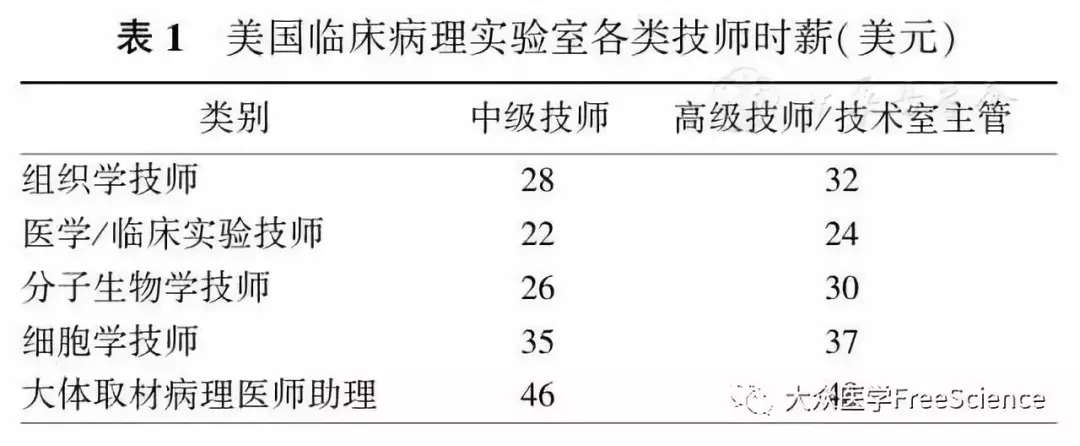
In medical schools and clinical hospitals, pathology technician levels are generally divided into technician/technologist, chief/lead technician, senior technician, or technologist, with an average annual income ranging from $40,000 to $60,000. Expert-level senior technicians or those working in companies earn $60,000 to $80,000 or more (Table 1). Clinical laboratory pathology technicians are generally protected by the Department of Labor, and labor unions protect members’ labor rights, such as negotiating salary increases and striving for maximum labor protection and related benefits. Work contracts are typically signed every three years, with an annual salary increase of about 2% to 3%. Personal benefits include vacation benefits, overtime pay, medical insurance plans, pension systems, personal and children’s education plans, etc., such as free medical and dental insurance covering spouses and children up to 26 years old, and education fund systems that reduce tuition fees for children attending the employer’s university.
In China, clinical pathology departments generally belong to hospital auxiliary departments. With the increasing importance of clinical pathological diagnosis work, the position of pathology technician is also becoming more attractive to young pathological technical talents. Overall, the position is relatively stable, but due to differences in regions or units, different employment sequence systems, etc., technician ranks, income, and benefits may vary significantly.
Technicians are generally divided into junior level I (technician), junior level II (technologist), intermediate level (chief technician), associate senior level (associate chief technician/senior laboratory technician), and senior level (chief technician). The general monthly salary plus various subsidies ranges from 5,000 to 10,000 yuan. Most employers can provide basic medical insurance, retirement plans, and personal education plans. However, with the increasing gap in income, benefits, and working environments between clinical pathotechnology laboratories and clinical departments and other medical-technical departments, the pathology technician workforce also faces issues of instability and shortage of technical talents.
Through observations of clinical pathotechnology laboratories in China and the United States in terms of laboratory structure construction, management and operation, technician education and training, and compensation and benefits, we recognize that the developmental advantages of pathology laboratories in China lie in the growth of hardware investment, improvement of working environments, increase in the number of technical reserve talents, and enhancement of educational backgrounds. This is attributed to the joint efforts of several generations of pathologists and technical experts. However, gaps and deficiencies still exist in operational management mechanisms, technician training systems, academic exchanges, etc. These conclusions will provide references for future improvements.
As Professor Wang Boyun, a renowned pathological technical expert in China, said: “Because the wheel of pathological technology is smaller than the large wheel of pathology, there has been long-term disharmony. Now the state supports the pathological technology specialty and develops pathological technology science, so that these two wheels can rotate simultaneously and harmoniously.” To adapt to the development of modern medical technology and meet the needs of clinical pathological diagnosis work, it is urgent to establish and standardize the specialty of pathological technology science and vigorously develop modern pathological laboratories and technician teams.
This urgently requires more practical measures, such as competent authorities issuing policies to strengthen the construction of the pathological technology discipline, professional societies establishing laboratory and technical talent certification systems, employers improving the treatment of technical talents and optimizing promotion mechanisms, establishing training mechanisms for specialized technical technicians and expert technicians, and strengthening international academic exchanges and cooperation in the field of pathological technology science. Only in this way can we adapt to the progress of pathological technology in the new era and accelerate the development of modern pathology in China. This is also the strong desire and common responsibility of pathology experts and pathological technology experts.
Source of this article:Chinese Journal of Pathology, 2017, 46(04): 286-288.
Authors:Wang Xiaodong, Bian Xiuwu