Hotspot Focus

Thirteenth Issue of “Mai Mai” Pathology Weekly Reading Notes | Immunohistochemical Markers for Hepatobiliary Tumors


Preface:


The anatomical positions and even histogenesis of the liver and gallbladder are closely related; in practical work, liver and gallbladder-related lesions often require comprehensive consideration, such as the differentiation between intrahepatic cholangiocarcinoma and hepatocellular carcinoma. Immunohistochemistry plays an important role in this. This section provides a detailed introduction to the immunohistochemical markers for common liver and gallbladder tumors, hoping to assist pathology colleagues in daily diagnosis.


图片

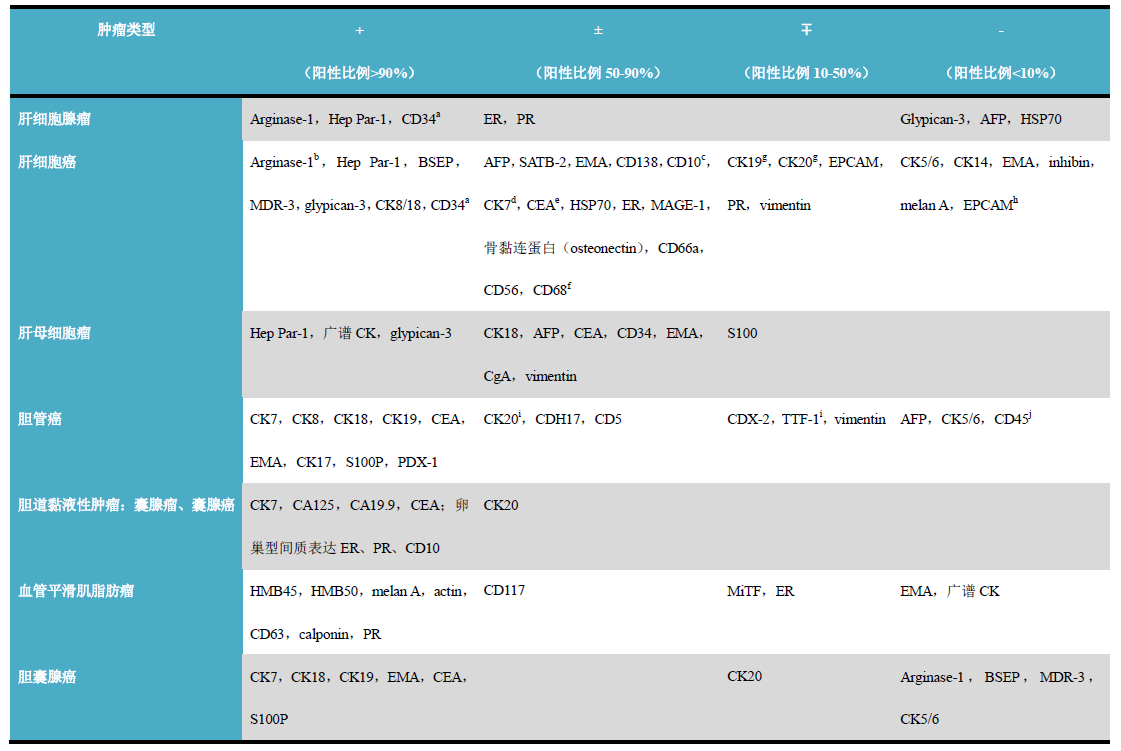
The immunohistochemical marker status of common liver and gallbladder tumors is detailed in Table 1.


Table 1. Overview of Commonly Used Immunohistochemical Markers for Hepatobiliary Tumors
图片

(Click to view larger image)


Remarks

  1. Marks the sinusoidal endothelial cells within the tumor trabeculae; normal liver parenchyma does not express or rarely expresses it.

  2. The degree of positive expression is related to the differentiation of hepatocellular carcinoma;

  3. Apical staining of small bile ducts;

  4. Strongly positive staining in fibrolamellar hepatocellular carcinoma, up to 50% staining in classical hepatocellular carcinoma, but normal hepatocytes are generally negative;

  5. Only polyclonal CEA shows small bile duct staining, while monoclonal antibodies are negative;

  6. Positive in fibrolamellar hepatocellular carcinoma, negative in classical hepatocellular carcinoma and normal hepatocytes;

  7. Normal hepatocytes are negative;

  8. EPCAM (BerEP-4) is generally positive in hepatoid carcinoma but negative in hepatocellular carcinoma;

  9. CK20 and TTF-1 positivity are unique features of carcinomas originating from extrahepatic bile ducts; intrahepatic bile duct carcinomas are generally negative;

  10. CD56 positivity is seen only in a very small number of carcinomas originating from intrahepatic bile ducts.
图片

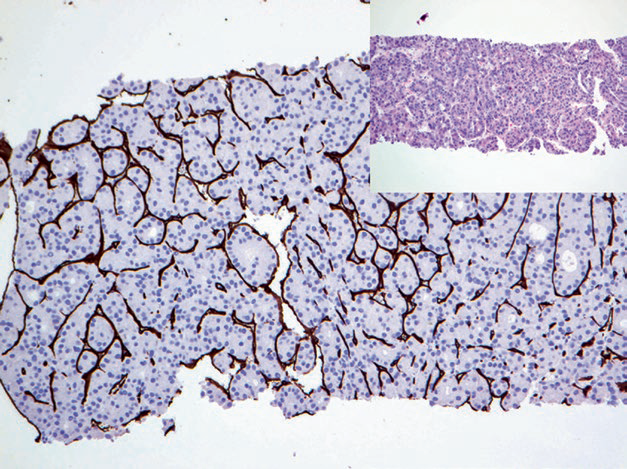
Figure 1. Hepatocellular carcinoma, immunohistochemistry CD34, sinusoidal endothelial cells positive.


Some indicators in Table 1 are discussed in other chapters. It should be noted that PDX-1 is relatively sensitive for primary cholangiocarcinoma. TTF-1 is generally considered a specific marker for lung and thyroid cancers, but weak to moderate nuclear staining can also be seen in cholangiocarcinoma, so it can be used to differentiate liver tumors from metastatic carcinomas.


Detailed Explanation of Some Immunohistochemical Indicators for Hepatocellular Tumors


1


 Hepatocyte

Hepatocyte, also known as Hep Par-1, reacts with urea cycle enzymes on the mitochondrial membrane of hepatocytes and is also expressed in the mitochondria of intestinal epithelial and renal tubular cells. Overall, this marker is specific for liver tissue and hepatocellular tumors but can also be expressed in small intestinal mucosa, small intestinal adenocarcinoma, and gastric and esophageal intestinal metaplasia including Barrett’s mucosa.

Positive expression pattern: Cytoplasmic (granular staining)

Recommended positive control tissue: Liver tissue


Generally, extrahepatic tumors with hepatocellular differentiation have an immunophenotype consistent with hepatocellular tumors, so Hep Par-1, AFP, and CD10 are also positive. It has been reported that adrenal cortical tumors, gastric and small intestinal adenocarcinomas, etc., can also express them, but these tumors do not express arginase.


2


 Arginase-1

Arginase-1 catalyzes the conversion of arginine to ornithine and urea. For the gastrointestinal tract, arginase-1 expression is limited to hepatocytes, while bile duct epithelium and sinusoidal endothelial cells of the liver do not express it. For hepatocytes and hepatocellular carcinoma, arginase-1 is more specific than Hep Par-1, with a positive rate of 85-100% in primary and metastatic hepatocellular carcinoma; and the degree of positivity of this marker is related to the tumor differentiation grade. Varying degrees of arginase-1 expression can also be seen in myeloid cells and macrophages.


3


 Alpha-fetoprotein

Alpha-fetoprotein (AFP) is an oncofetal protein found in fetal liver tissue, fetal digestive tract, yolk sac, and fetal plasma. There are also very low levels of AFP in adult plasma. Most cases of hepatocellular carcinoma show high levels of AFP expression, with slightly lower expression levels in germ cell tumors (such as yolk sac tumors). However, about 5% of hepatocellular carcinomas do not express AFP. Low-level expression of AFP has also been reported in pancreatic acinar cell carcinoma, pancreatoblastoma, and renal cell carcinoma.

图片

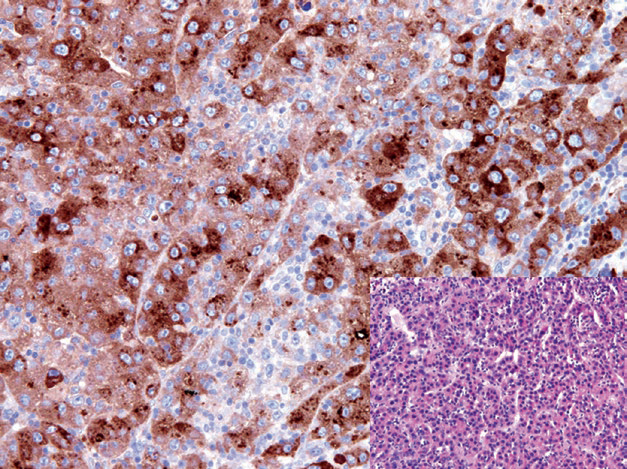
Figure 2. Hepatocellular carcinoma, tumor cells strongly positive for AFP.


Positive expression pattern: Cytoplasmic

Recommended positive control tissue: Fetal liver tissue


4


Glypican-3

This is a heparan sulfate proteoglycan involved in regulating signaling pathways during embryogenesis. Normally, Glypican-3 is expressed in fetal tissues and trophoblasts. In adult tissues, Glypican-3 expression is limited to a few tissues, such as gastric glands and renal tubules. However, this marker is expressed in various epithelial and mesenchymal tumors, such as lung squamous cell carcinoma, small cell carcinoma, hepatocellular carcinoma, hepatoblastoma, pancreatic acinar cell carcinoma, neuroblastoma, Wilms tumor, yolk sac tumor, choriocarcinoma, liposarcoma, and rhabdomyosarcoma. Embryonal carcinoma and seminoma do not express Glypican-3.
Glypican-3 helps differentiate hepatocellular carcinoma from benign liver tissue, but it is important to note: focal expression of this marker may occur in cirrhotic liver tissue, chronic active hepatitis C, and dysplastic liver nodules.

图片

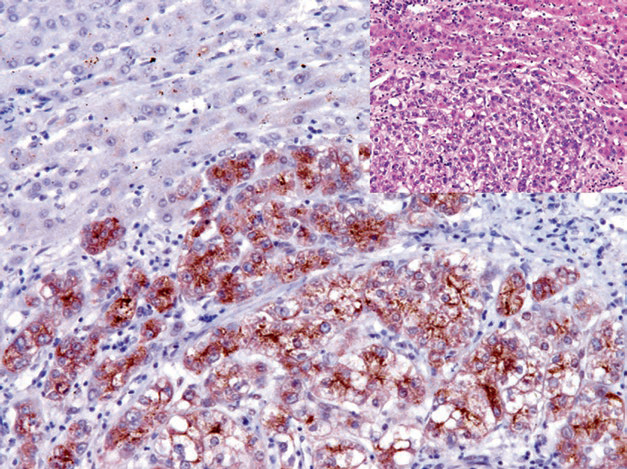
Figure 3. Hepatocellular carcinoma, immunohistochemistry Glypican-3 positive; non-neoplastic liver tissue in the background is negative.


5


 BSEP and MDR-3

Bile salt export pump (BSEP) is a member of the ATP-binding cassette transporter family encoded by the ABCB11 gene. It is a membrane-associated ATP-dependent bile salt transporter located on bile canaliculi microvilli and hepatocyte vesicles, functioning to transport conjugated bile salts from hepatocytes into the bile canalicular system. Multidrug resistance protein 3 (MDR-3) is another member of the same transporter family and is also a transmembrane protein involved in bile salt transport within hepatocytes. Both BSEP and MDR-3 are expressed only on the cell membrane of hepatocytes and can be used as sensitive and specific markers for hepatocytes and hepatocellular tumors, and for differentiating hepatocellular tumors from bile duct tumors.


6


 HSP70

Heat-shock protein-70 (HSP70) is an anti-apoptotic regulator expressed in various malignant tumors. In routine immunohistochemical testing, HSP70 can be used to differentiate hepatocellular carcinoma from dysplastic nodules and hepatocellular adenoma, with the latter two being negative and the former showing nuclear/cytoplasmic positive staining. Because HSP70 is expressed in many different malignant tumors, this marker cannot be used to differentiate hepatocellular carcinoma from metastatic carcinoma.

1


Mai Mai: “Arginase-1 is a sensitive and specific marker for hepatocellular adenoma and hepatocellular carcinoma, and can be combined with Glypican-3 and Hepatocyte for the differential diagnosis of primary hepatocellular carcinoma from metastatic tumors and cholangiocarcinoma.Glypican-3 is expressed in embryonic liver, kidney, lung tissues, and the trophoblast layer of placental tissue, while other normal tissues do not express it,Positive expression can be seen in neoplastic tissues such as hepatocellular carcinoma, yolk sac tumor, choriocarcinoma, and melanoma. Combined use with CD34 can help differentiate benign from malignant hepatocellular tumors.”

Antibody Name

Clone Number

Positive Control

Positive Location

Arginase-1

EP261

Liver, Liver Cancer

Cytoplasmic/Nuclear

Hepatocyte

OCH1E5

Liver Tissue, Hepatocellular Carcinoma

Cytoplasmic

Glypican-3*

MAXIM001

Liver Cancer, Placenta

Cytoplasmic

*Marked as Maxin Clone Products


For more information, please contact: 800-8581156 or 400-889-9853

发表回复

您的邮箱地址不会被公开。 必填项已用 * 标注