
Hotspot Focus

Pathology Weekly Reading Notes by “Mai Mai” | Issue 1


Preface:


In the world of pathology, one phrase that pathologists frequently encounter is, ‘Let’s do immunohistochemistry…’

Indeed, if pathology were a martial arts world, routine diagnosis would be akin to basic hand-to-hand combat, while immunohistochemistry would be the weapon or hidden weapon: to some extent, it is more powerful and precise in pathological diagnosis.

However, precisely because pathology is a martial arts world, the choice of weapon or hidden weapon is extremely nuanced: just considering swords, should one use the ‘heavy sword without an edge, great skill appears clumsy’ Xuantie heavy sword, or the uniquely shaped and oddly used Golden Snake Sword? This depends on the ‘enemy’ faced (specific disease types and differential diagnoses), while also considering one’s own conditions (such as laboratory capabilities). After all, it’s hard to imagine the majestic Fourth Master of the Red Flower Society, Wen Tailai, spitting date pit nails!

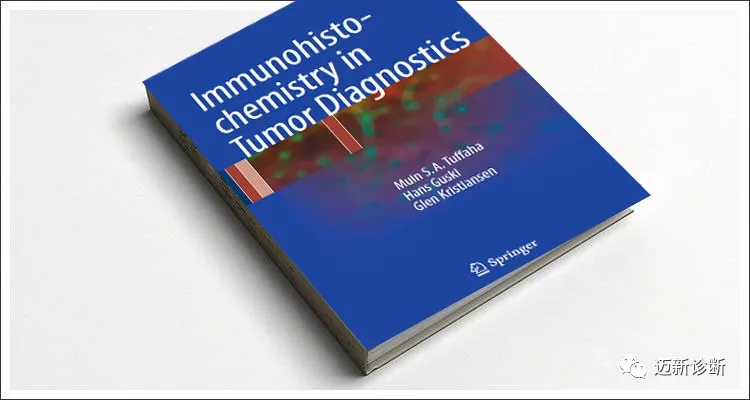
Recently, the editor had the privilege of reading Springer’s book ‘Immunohistochemistry in Tumor Diagnostics.’ The book provides detailed insights into the key applications of immunohistochemistry in tumor diagnosis, including recommended ‘panels’ for different diseases and explanations of specific marker applications. We have compiled our reading notes to share with everyone, hoping to provide as much assistance as possible in your work.


图片


Overview of Immunohistochemistry

Since the emergence of immunohistochemistry in the 1940s, the technique has gradually developed into an important tool in pathological diagnosis, especially in tumor pathology. With ongoing research, it also provides crucial information for the treatment of tumor patients. Particularly in the last one to two decades, immunohistochemistry has rapidly evolved into a highly specific molecular testing method, becoming an indispensable tool in the daily diagnosis of pathologists.
Currently, thousands of immunohistochemical antibodies are available for use, ranging from monoclonal to polyclonal, targeting intracellular to extracellular structures. Its applications widely involve frozen tissues, formalin-fixed paraffin-embedded tissues, and cytological specimens. The purposes of its use have expanded from initially determining tumor histological classification to detecting tumor residues in certain situations (such as margins, lymph nodes), testing markers with therapeutic and prognostic significance, and even semi-quantitative immunohistochemical detection, all of which are important for clinical staging and treatment.
 

Staining Patterns of Immunohistochemical Markers

Immunohistochemistry determines negative or positive results based on the presence or absence of staining in the target area by specific antibodies, but the staining patterns vary, related to specific diseases and antibody types. In terms of staining patterns, they can be simply categorized as follows:
  1. Nuclear Staining: This occurs when antigens are expressed in the nucleus or nuclear membrane; examples include transcription factors and steroid hormone receptors.

  2. Cytoplasmic Staining: This occurs when antigens are localized in the cytoplasm; examples include cytoskeletal proteins (vimentin, actin, desmin, CK). Some antigens can be further subdivided within the cytoplasm, such as localization to mitochondria (resulting in granular cytoplasmic staining) or the Golgi apparatus (resulting in perinuclear staining).

  3. Membrane Staining: This occurs when antigens are localized on the cell membrane; typical examples include most CD series antigens.

  4. Extracellular Staining: This involves staining of extracellular and tissue matrix antigens, as well as secreted products of cells; examples include collagen components and CEA.

Although immunohistochemical staining patterns can be simply divided into the above four categories, some antigens may exhibit different staining patterns depending on the cell cycle or differentiation stage. The expression of immunoglobulins in lymphoid tissue is a typical example. Additionally, some antigens may show special staining patterns depending on the specific tumor type.
However, it is important to remind everyone that while immunohistochemistry results may seem as simple as negative or positive (with exceptions for certain markers), their interpretation must be combined with morphological findings on HE slides, fully considering the characteristics and expected expression patterns of each antibody. Attention must also be paid to external controls and internal positive and negative controls in the examined tissue to make reliable determinations.
  

Immunohistochemistry ‘Panels’ in Tumor Diagnosis
As mentioned earlier, there are currently thousands of immunohistochemical antibodies available for clinical use, with hundreds commonly used! In practice, selecting antibodies that are ‘few but precise’ based on their sensitivity and specificity to reach clear conclusions tests the experience and skill of pathologists. However, the histological morphology of the tumor, its location, and clinical information provide important guidance for antibody selection.
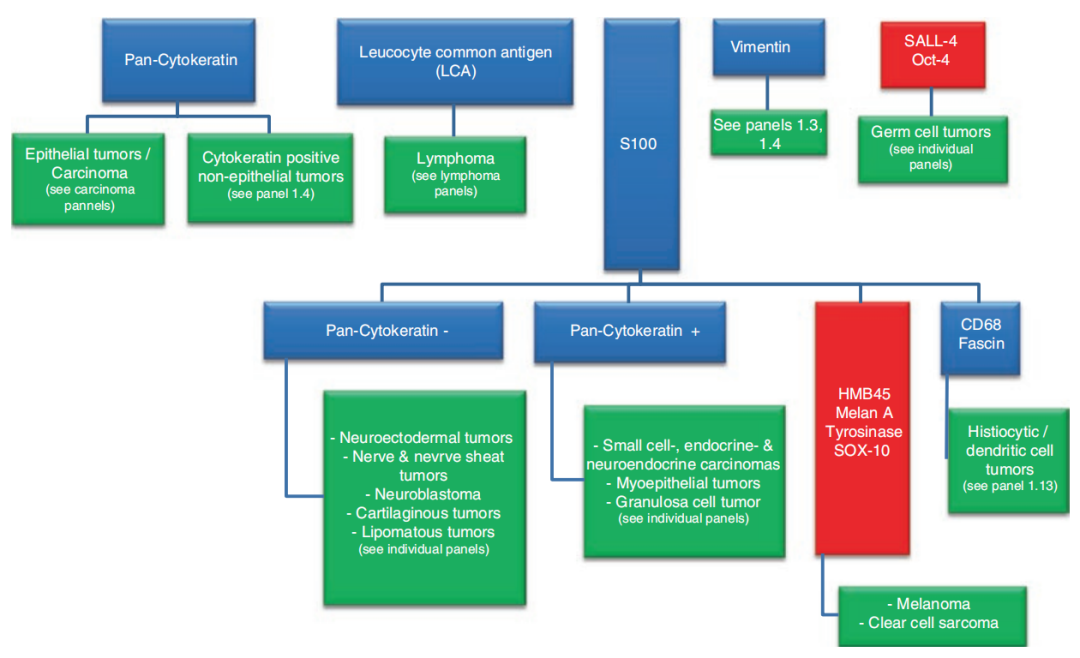
For tumors with unclear morphological direction or undetermined tissue differentiation, the book provides a time-saving, cost-effective, and highly instructive immunohistochemistry panel that can basically determine whether the lesion belongs to epithelial, mesenchymal, neural, or hematopoietic systems. The markers used are: broad-spectrum CK, LCA, S100 and HMB45, Oct4 or SALL4, and vimentin. The interpretation of specific results is detailed in Figure 2. Based on this preliminary screening panel, more targeted immunohistochemistry panels can be selected according to specific situations.
Before learning about specific panels, it should be noted: in the corresponding immunohistochemistry panel combinations and further testing flowcharts in the book, blue boxes represent routine screening markers, red boxes represent relatively more specific markers, and green boxes represent the most likely markers; the same applies in the following sections.
Additionally, in tumor immunohistochemistry, there may always be exceptions or abnormal expression of certain antigens, which could lead to misdiagnosis. As mentioned earlier, the interpretation of immunohistochemical markers must be closely combined with morphological findings. In short, no single immunohistochemical marker is completely specific or exclusive to a particular tumor type.

图片

Figure 2. Preliminary screening immunohistochemistry panel for tumors with unclear morphological direction or undetermined tissue differentiation

Detailed Explanation of Figure 2:
  1. If broad-spectrum CK is positive, there are two considerations: epithelial tumors (malignant cases are carcinomas) and CK-positive non-epithelial tumors.

  2. If LCA is positive, lymphoma is often considered; details will be discussed later.

  3. If vimentin is positive, the situation is more complex and requires detailed analysis combined with CK status; details will be discussed later.

  4. If SALL-4 or Oct-4 is positive, germ cell tumors are often considered.

  5. If S100 is positive, further analysis with other markers is needed: A. If broad-spectrum CK is negative, consider neuroectodermal tumors, neurogenic tumors, nerve sheath tumors, neuroblastoma, chondroid tumors, lipomatous tumors, etc.; B. If broad-spectrum CK is positive, consider small cell carcinoma, neuroendocrine carcinoma, myoepithelial tumors, granular cell tumors, etc.; C. If HMB45, Melan A, tyrosinase, or SOX-10 are positive, consider malignant melanoma, clear cell sarcoma; D. If CD68 or Fascin is positive, consider histiocytic/dendritic cell tumors.

To be continued…….

发表回复

您的邮箱地址不会被公开。 必填项已用 * 标注