Industry News

In the Era of Precision Medicine, the Importance of Pathological Diagnosis is Highlighted—Latest “Clinical Rational Use Management Indicators for Antitumor Drugs” Released


Introduction:


On June 28, 2021, to implement the “Administrative Measures for Clinical Application of Antineoplastic Drugs (Trial)” (National Health Commission Medical Letter [2020] No. 487), the National Health Commission formulated and issued the “Management Indicators for Rational Clinical Application of Antineoplastic Drugs (2021 Edition)” to guide medical institutions in scientifically setting management indicators for the clinical application of antineoplastic drugs and improving the level of rational clinical application of antineoplastic drugs.


With the continuous deepening of medical research and the rapid development of the biopharmaceutical industry, new drugs in the field of oncology are emerging one after another, providing more choices for clinical treatment and significantly improving the level of cancer treatment. However, expensive antineoplastic drugs and an imperfect medical diagnosis and treatment system have led to the irrational use of various antineoplastic drugs, causing social controversy and drawing attention from national departments. For this reason, the National Health Commission organized the formulation and issuance of the “Management Indicators for Rational Clinical Application of Antineoplastic Drugs (2021 Edition)” (hereinafter referred to as the “Indicators”).

Key Points of the Document

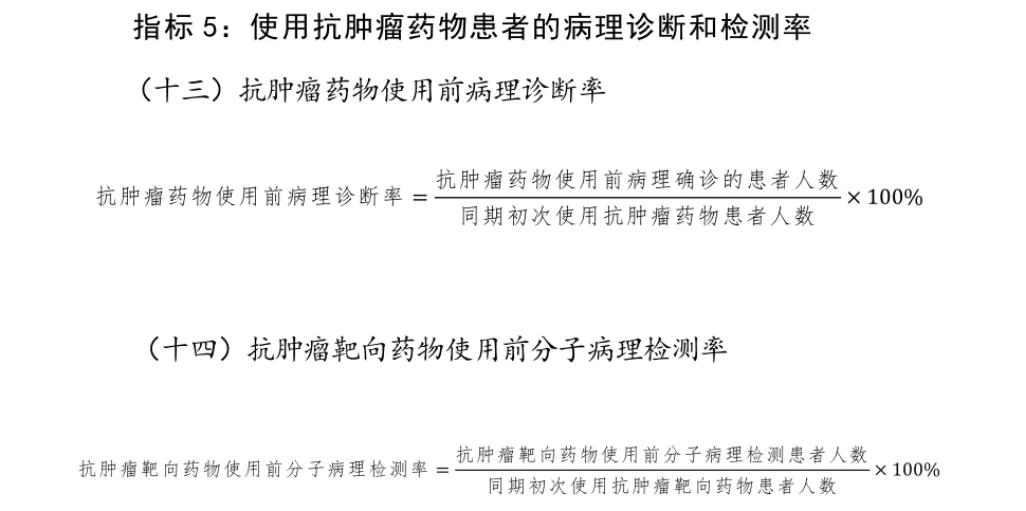
This “Indicators” proposes six indicators regarding the use of antineoplastic drugs, among which the editor is most concerned about Indicator 5: The rate of pathological diagnosis and testing for patients using antineoplastic drugs.
图片

Significance:
The rate of pathological diagnosis and testing for patients using antineoplastic drugs refers to the percentage of cancer patients who undergo tissue/cytological or molecular pathological diagnosis and testing before starting antineoplastic drug and targeted therapy. It aims to monitor the guidance of pathological diagnosis and testing for the rational use of antineoplastic drugs and targeted therapies in patients, avoiding misdiagnosis, mistreatment, and blind medication.

Explanation:
  1. In principle, only malignant tumors confirmed by tissue or cytological pathological diagnosis or established by special molecular pathological testing have indications for the use of antineoplastic drugs and targeted therapies. Cancer patients diagnosed solely based on clinical symptoms, signs, and imaging results without pathological confirmation have no indication for the use of antineoplastic drugs and targeted therapies;

  2. For certain tumors where pathological diagnosis is difficult to obtain, such as pancreatic cancer, the diagnosis can be made with reference to relevant national guidelines or standards;

  3. For antineoplastic targeted drugs with clear targets, corresponding target testing must be performed before use;

  4. Pathological reports should be credible and must be issued by medical institutions with appropriate qualifications, including pathological diagnosis and testing reports or pathological consultation reports;

  5. The denominator is the number of patients initially treated with antineoplastic drugs and targeted therapies.


Pathological Diagnosis Facilitates Precision Medicine

“Pathological diagnosis is the gold standard for cancer diagnosis,” widely recognized in the medical community as the most reliable, reproducible, and accurate diagnostic method. It not only determines the benign or malignant nature, classification, and grading of tumors, providing the final diagnosis of the disease, but also guides clinicians in prognosis assessment and drug selection, offering crucial evidence for patient treatment. It is the core of precision medicine.
The “Indicators” document clearly states:“In principle, medication should not be administered without pathological diagnosis.Only malignant tumors confirmed by pathological diagnosis or established by special molecular pathological testing have indications for the use of antineoplastic drugs and targeted therapies.” Thishighlights the importance of pathological diagnosis in the era of precision medicine.
It also signifiesThe Importance of Pathological Diagnosis is Increasingly Recognizedthat the formulation of relevant national regulations and policy support will effectively promote the development of the pathology industry towards “standardized processes and standardized operations,” actively enhance the level and quality of pathological diagnosis, and even drive innovation in pathological technology. The pathology industry will usher in a vibrant spring of development!


发表回复

您的邮箱地址不会被公开。 必填项已用 * 标注